

Martina Dimoska: Building Humanity’s Next Frontier
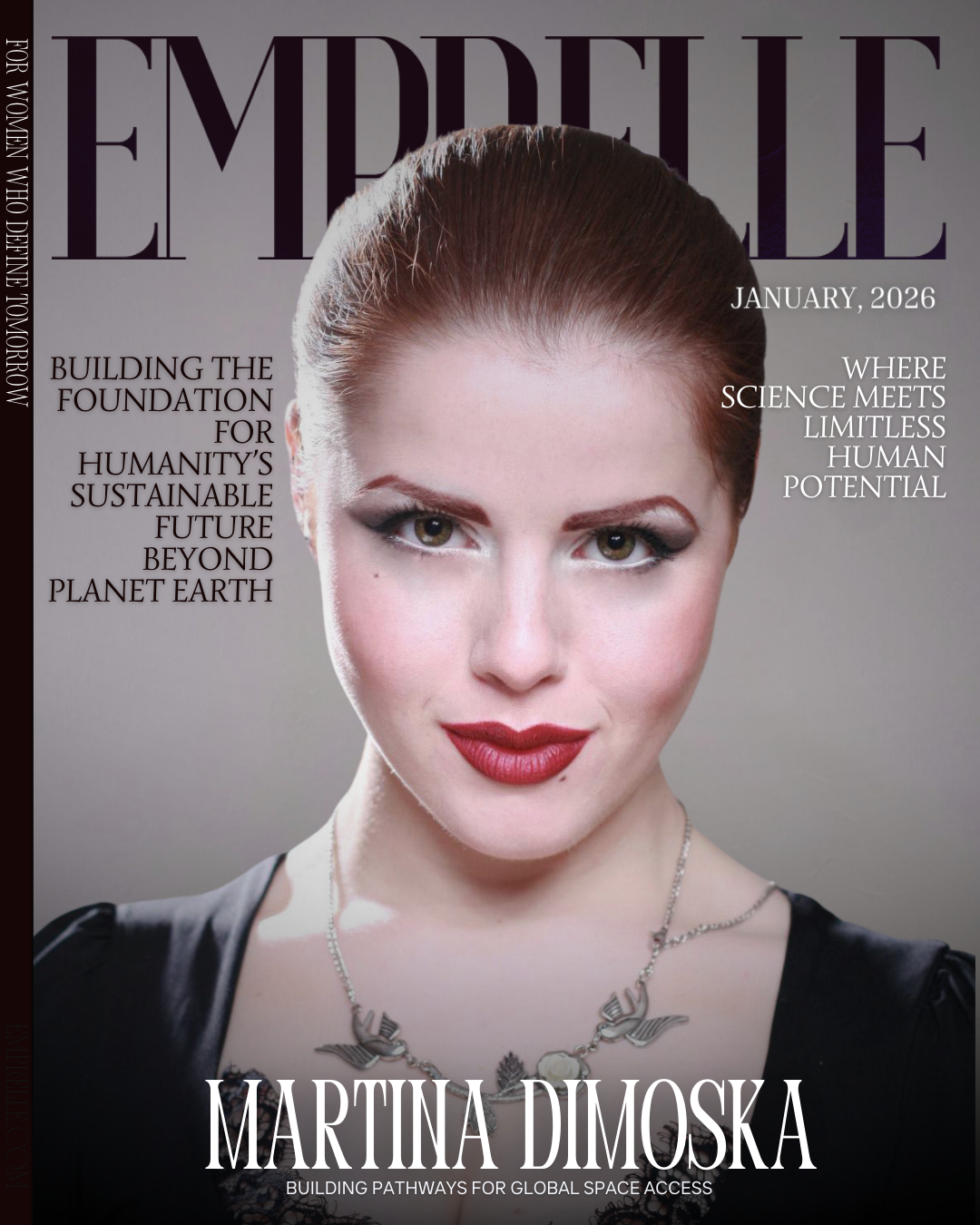
From a Path That Didn’t Exist to a Future That Includes Everyone
Martina Dimoska does not describe her journey into the space sector as linear, comfortable, or predetermined. Instead, she describes it as necessary. Necessary because curiosity demanded it. Necessary because the pursuit of truth would not let her remain still. Necessary because coming from a country without a developed space ecosystem meant waiting for opportunity was never an option.
More than a decade ago, Dimoska realized something that would quietly shape her life’s direction: she had the capacity to contribute meaningfully to the space sector, even if no visible path existed. Rather than seeing this absence as a barrier, she treated it as an invitation to build.
“I started creating small initiatives,” she explains, “bringing together students, researchers, and international collaborators who shared the same passion.” What began as informal efforts to learn and connect gradually evolved into something far more consequential. Those early collaborations became the foundation for her work in in-situ resource utilization (ISRU), human spaceflight, and space systems development, as well as contributions to organizations such as Blue Abyss. Most notably, she founded the International Space Alliance (ISA) and led the establishment of the first Civil Macedonian Space Agency as the first founding member.
The Ultimate Pursuit of Truth

At the heart of Dimoska’s story is a singular driving force: what she calls “the ultimate pursuit of truth.” It is the timeless human question of who we are and where we belong in the universe. For her, that question naturally expands into a bold vision – making humanity extraplanetary.
“I was inspired by the idea that humanity should not be confined to one planet,” she says. “Extending human presence beyond Earth through knowledge, cooperation, and shared purpose is one of the most meaningful challenges we can take on.”
This philosophy informs not only her research interests, but also the deeper gap she is working to bridge: access to space. Dimoska’s mission is to help make space exploration more inclusive, practical, and globally accessible, with the long-term goal of enabling humanity to survive and thrive beyond Earth.
Building Where Nothing Exists
What distinguishes her approach is not only technical competence, but adaptability and perseverance forged through adversity. Building a career without institutional scaffolding required creativity, resilience, and a willingness to operate in years facing uncertainty.
“I learned how to build progress in environments where structures do not yet exist,” she says. “That experience shapes everything I do.”
She approaches challenges with a builder’s mindset – identifying what is missing, assembling the right people, and constructing solutions from the ground up.
Recognized at the Highest Level
Her work has earned formal recognition at the highest levels. One of her proudest milestones is obtaining the EB-1A Green Card – often referred to as the “Einstein Green Card” – an extraordinary ability classification reserved for individuals at the very top of their fields, such as Nobel Prize Winners, Olympic Gold Medalists, and Pulitzer Prize Awardees.
The recognition by the U.S. government validated years of work carried out largely without traditional pathways. Yet what followed is perhaps even more striking.
Within just three months of receiving EB-1A recognition, while simultaneously relocating to the United States and navigating the complexities of assimilation, Dimoska collaborated with the French Space Agency (CNES) as part of the international Act In Space initiative. During that same period, she was accepted into NASA’s L’SPACE NPWEE Academy.
Inside the NASA Pipeline
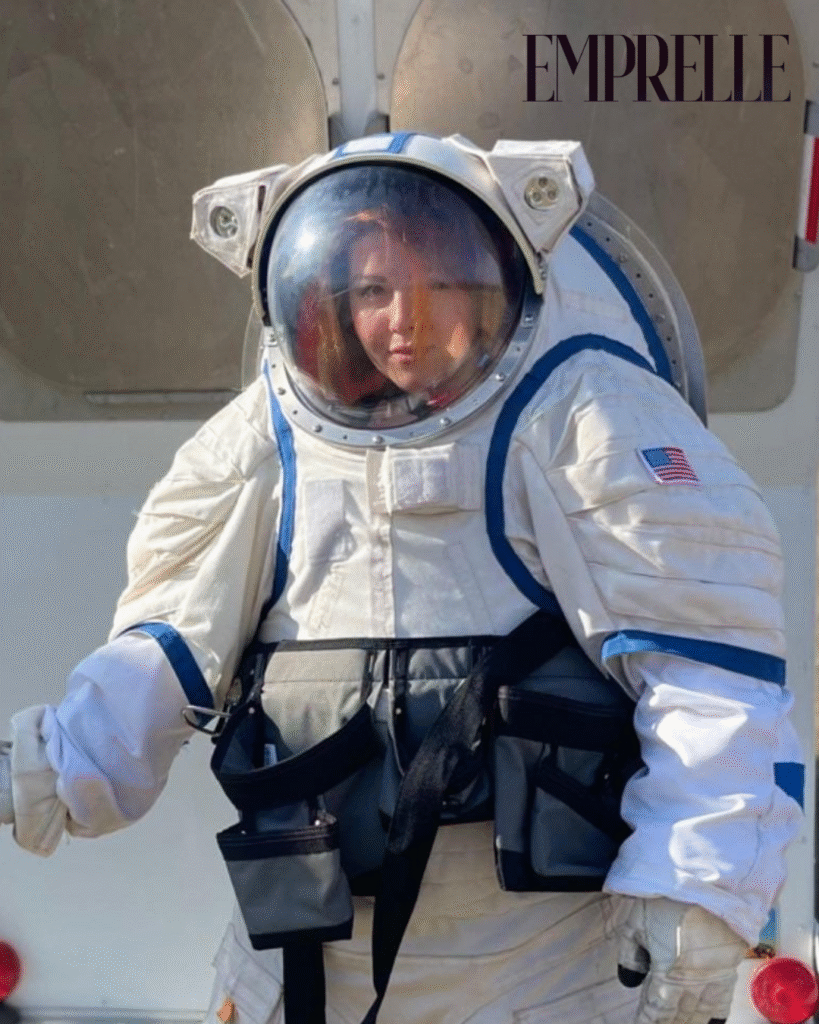
As a NASA NPWEE Associate, Martina Dimoska contributes to mission-aligned proposal formulation and evaluation within a structured workforce pipeline designed to prepare future professionals for careers at NASA and across the broader U.S. and commercial space ecosystem.
She is currently part of an interdisciplinary working group focused on Human Exploration and Space Habitation, within a program aligned with the Lucy Mission. Through this pipeline-based program, she supports the development of a full NASA-style research proposal addressing identified agency science and programmatic gaps. Her responsibilities span mission context analysis, science traceability, and alignment with planetary science, human exploration, and downstream industry-relevant priorities.
For Dimoska, these roles represent more than credentials. They represent responsibility.
Choosing Projects That Move the Needle
Dimoska describes her project selection process with refreshing clarity: she asks how quickly and meaningfully a project moves the needle forward – both in immediate real-world impact and long-term value.
This principle shapes her work across research, policy, education, and organizational leadership.
Scaling a Global Vision

The next chapter of the International Space Alliance reflects this philosophy. With registered operations now established in North Macedonia, Europe, and in the Bay Area, Silicon Valley, California, U.S.A., ISA is entering a phase of organizational maturity – strengthening internal systems, refining program foundations, and preparing for a new wave of initiatives across education, applied deep-tech, space technologies, innovation, and international collaboration.
On a personal level, Dimoska hints at additional career developments underway, still confidential but deeply promising. Her trajectory suggests that her influence within the global space ecosystem is only beginning to accelerate.
A Human Definition of Success
Despite the scale of her accomplishments, Dimoska defines success in profoundly human terms.
“Success is measured by how many lives I have touched and changed for the better by opening doors and creating opportunities,” she says.
What motivates her most is an acute awareness of time.
“We have this one life,” she reflects, “and a responsibility to live it to its fullest possible capacity in service of something meaningful.”
Designing a Future That Includes Everyone
In an era where space is often framed through competition, geopolitics, and spectacle, Martina Dimoska represents a different archetype: the builder of bridges, the architect of access, the quiet force expanding humanity’s horizons not only through technology, but through community.
She is not simply preparing for humanity’s future beyond Earth.
She is helping to design who gets to be part of it.