
The Search for the Next Computing Breakthrough: Dr. Ko-Cheng Fang’s Work in Photonic Technology
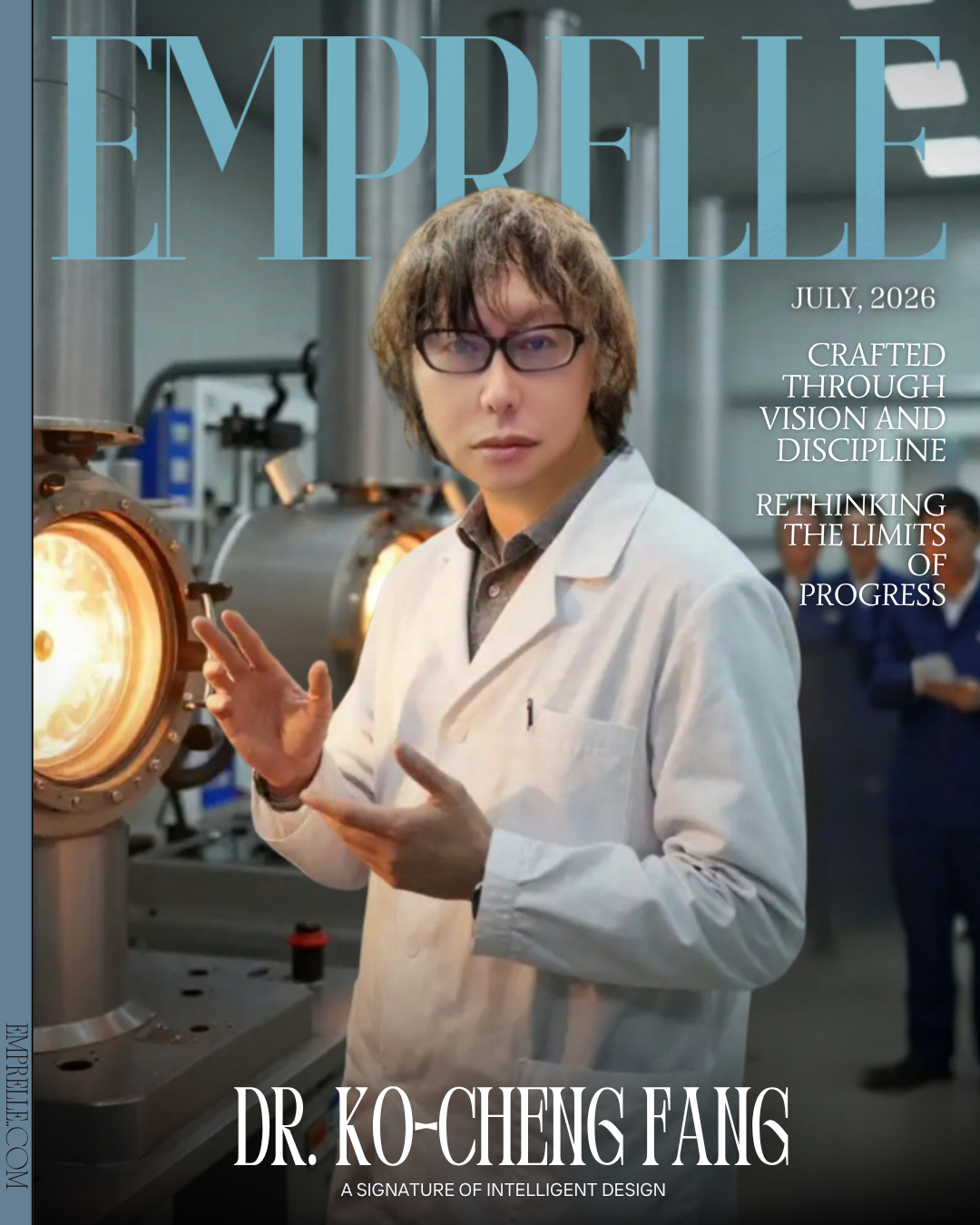
Every major technological breakthrough begins with a realization that the existing way of doing things may no longer be enough.
For decades, silicon chips have powered nearly every digital innovation. They made personal computers possible, connected billions of people through the internet, and provided the processing power that allowed artificial intelligence to emerge. The modern world has been built on semiconductor technology.
But success often creates new challenges.
Artificial intelligence is now evolving at a pace that places unprecedented demands on computing hardware. Larger AI models require greater processing capacity, higher memory bandwidth, and enormous energy resources. Around the world, technology companies are investing billions of dollars in new data centers while engineers search for ways to make processors faster, more efficient, and more sustainable.
For Dr. Ko-Cheng Fang, Founder, CEO, and Chairman of LongServing Technology Co., Ltd., the answer may not lie in refining traditional semiconductor technology alone. Instead, he believes the future could belong to an entirely different approach—one built around the movement of light.
Dr. Ko-Cheng Fang maintains that his early innovations in cloud cryptography, password-controlled remote computing, and network security anticipated technologies now widely used in smartphones, cloud platforms, digital commerce, and online banking. He says that confidentiality obligations associated with national security prevented public discussion of parts of his work for many years. Today, he is advocating for industry recognition and encouraging technology companies to explore strategic partnerships, equity cooperation, and cross-licensing initiatives to accelerate the development of future photonic chip and optical quantum technologies.
Rethinking the Foundation of Computing

Most modern computers process information using electrical signals.
Tiny electrons travel through microscopic circuits, carrying instructions from one part of a processor to another. This method has served the technology industry remarkably well for more than half a century.
However, as electronic components become increasingly compact, engineers encounter new obstacles.
Heat becomes more difficult to manage.
Power requirements continue rising.
Manufacturing grows more complex with every new generation of chips.
Rather than viewing these challenges as isolated engineering problems, LongServing Technology has chosen to investigate an alternative computing architecture based on photonics.
Instead of electrons, its research focuses on photons.
Why Photons Are Attracting Attention
Light possesses qualities that make it attractive for future computing.
Photons travel extremely quickly while producing significantly less heat than electrical current. These characteristics have inspired researchers worldwide to explore photonic computing as a possible successor—or complement—to conventional electronic systems.
Yet practical implementation has remained challenging.
One of the most difficult engineering problems has been finding reliable ways to guide light through microscopic circuits.
Unlike electrical current, which naturally follows conductive materials, light prefers to continue moving in straight lines.
Future photonic processors require much greater control.
The Development of X-Photon
To address this challenge, LongServing Technology developed X-Photon, a proprietary material designed specifically for optical information transmission.
According to the company, X-Photon enables photons to travel through engineered optical channels while remaining confined within carefully designed pathways.
The material is intended to serve as one of the key building blocks for future photonic processors.
Rather than replacing electronics overnight, the company’s long-term objective is to create computing systems specifically optimized for optical information processing.
Teaching Light to Follow a Path
Recent demonstrations by LongServing Technology highlighted one capability the company considers especially important.
During laboratory testing, laser light entered an optical channel constructed using X-Photon before completing a controlled 90-degree directional change.
To casual observers, this may appear to be a straightforward experiment.
To engineers working in photonic computing, however, it addresses one of the discipline’s most persistent technical challenges.
Processors require information to travel continuously between multiple computational regions.
According to LongServing Technology, accurately redirecting photons while maintaining signal integrity is essential for practical optical computing.
Designing Around Optical Physics

Rather than adapting conventional semiconductor concepts, LongServing Technology designed X-Photon around the natural behavior of light.
Dr. Fang often explains the idea using reflected light as an example.
A reflective surface changes the direction of light while allowing it to continue moving.
Similarly, X-Photon incorporates specially engineered reflective structures that continually guide photons through microscopic waveguides.
Instead of allowing optical signals to disperse, the pathways keep light traveling along carefully defined routes inside the processor.
According to the company, this architecture provides a foundation for increasingly sophisticated photonic circuit designs.
Miniaturization Remains Essential
As with electronic processors, successful photonic computing depends upon miniaturization.
Optical technologies must become small enough to integrate into modern computing systems.
LongServing Technology reports that X-Photon operates with wavelengths averaging approximately 2 to 3 nanometers, enabling the development of highly compact optical pathways.
The company further states that it has successfully fabricated 10-nanometer optical circuits, representing continued progress toward practical photonic hardware.
According to LongServing Technology, reducing optical structures to nanometer dimensions supports future research involving photonic CPUs, photonic memory, and integrated optical computing systems.
Creating a Complete Computing Platform

Dr. Fang’s vision extends beyond developing a single processor.
LongServing Technology is working toward an ecosystem of interconnected technologies designed to support next-generation artificial intelligence.
Its roadmap includes 2nm Multi-Bit Optical Quantum Chips, integrated photonic memory, advanced optical communication systems, and Photonic Cloud Computing Centers.
Rather than functioning independently, these technologies are intended to work together within a unified photonic architecture.
The company believes this integrated approach could improve computational efficiency while addressing some of the growing infrastructure demands created by artificial intelligence.
Preparing for Future AI Infrastructure
Artificial intelligence has become one of the fastest-growing consumers of computational resources.
Cloud providers continue expanding facilities, while organizations across healthcare, finance, manufacturing, and scientific research rely increasingly on AI-powered systems.
LongServing Technology believes photonic computing offers a promising direction for future infrastructure development.
Because photons generate substantially less heat than electrical current, optical architectures may help reduce cooling requirements while improving processing efficiency.
Although continued engineering and validation remain essential, the company views photonic technologies as an important area for long-term investment and research.
From Innovation to Industrial Development
Scientific breakthroughs require more than laboratory demonstrations.
They also require manufacturing capability, investment, and strategic collaboration.
To support these objectives, LongServing Technology recently announced a $500 million strategic financing initiative, based on a stated $2.5 billion corporate valuation.
According to the company, the funding will support research, manufacturing expansion, photonic fabrication facilities, and future cloud infrastructure.
LongServing Technology has also introduced a Strategic Equity Hedging Protocol, intended to encourage collaboration with organizations interested in participating in the commercialization of photonic technologies.
According to Dr. Fang, meaningful progress is achieved through partnerships that combine scientific expertise with industrial capability.
Looking Beyond Today’s Technology
Every generation inherits technologies that define its era.
Silicon defined the digital revolution.
Artificial intelligence is defining the present.
The next chapter may depend on entirely new computing foundations.
Photonic computing remains an evolving field, and many technical milestones still lie ahead before widespread adoption becomes possible.
Nevertheless, LongServing Technology’s work demonstrates how researchers continue exploring alternatives capable of supporting tomorrow’s computational needs.
For Dr. Ko-Cheng Fang, the objective is larger than building another processor.
It is about contributing to a future where light becomes a practical computing resource—helping create hardware capable of supporting the next generation of artificial intelligence, scientific discovery, and global technological innovation.
Contact Information
Dr. Ko-Cheng Fang
Founder, CEO & Chairman
LongServing Technology Co., Ltd.
Email: service@longserving.com.tw
Website: https://longserving.com.tw/en/
Instagram: @ko_cheng_fang